When you think of food safety, you likely think of expiration dates and best practices for storing and handling your produce, dairy, meat, and dry goods. But keeping foods and beverages safe from environmental hazards and free from contamination begins long before products reach grocery store shelves. It starts with a sterile production environment and packaging that maintains that sterility.
Ensuring that food and beverage packaging meets industry standards and can withstand being dropped, jostled, crushed, and exposed to fluctuating temperatures out the supply chain requires force and torque testing with accurate measurement equipment.
Here’s an introduction to force and torque testing for food and beverage packaging.
Why Food & Beverage Packaging Must Be Rigorously Tested
Improper packaging can lead to foodborne illnesses, which can be deadly. Packaging defects – such as poor adhesion on a yogurt lid, a micro-tear in deli meat packaging, or a loose lid on a bottle of unpasteurized orange juice – can make consumable products vulnerable to contamination by pathogens such as Salmonella, Listeria, and E. coli. The World Health Organization estimates that, each year, an estimated 600 million people are sickened by contaminated food worldwide, and 420,000 die.
Keeping food and beverages pathogen-free is the primary concern of food manufacturers, packaging professionals, and retailers – but the costs associated with poor packaging are another major concern. If packaging fails to protect products en route to the grocery store, they must be recalled and destroyed.
To add complexity, it isn’t enough for packaging to be strong and secure – it must also be accessible. Adhesive seals, bottle caps, and jar lids must be tight enough to create an airtight barrier, but not so tight that consumers can’t open them. Force and torque testing helps manufacturers find that balance.
Common Food & Beverage Packaging Force & Torque Tests
Common force and torque tests used to assess the integrity of food and beverage packaging include:
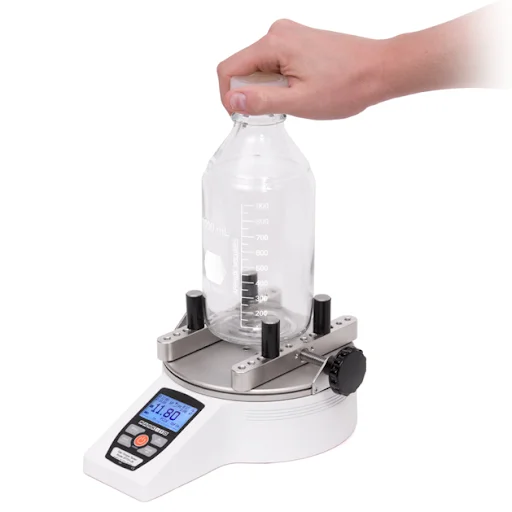
- Bottle cap torque testing: A bottle and its cap are held by grips affixed to a torque test stand and twisted to assess how much torque is needed to open and close the cap
- Bottle cap pull-off force testing: A bottle and its cap are held by grips affixed to a universal testing machine (UTM) and pulled to measure the force needed to remove the cap
- Top load testing: A container (like a plastic bottle or can) is placed in a UTM between plates and compressed to measure the force needed to crush the container
- Burst testing: A sealed flexible package (like a chip bag) is placed in a UTM between plates and compressed until it ruptures to measure how much pressure it can withstand before bursting
How to Select the Force & Torque Testing Equipment
Selecting the right force, torque, and compression measurement equipment depends on the food or beverage packaging you need to test. When sourcing your equipment, look for a manufacturer that prioritizes reliability, durability, and precision. Seek out a brand that specializes in thoughtful design and high-quality engineering.
Whether you’re new to food and beverage packaging testing or a seasoned professional, purchase your equipment from a manufacturer with robust customer support who can provide guidance and help you get the most out of your testing equipment.