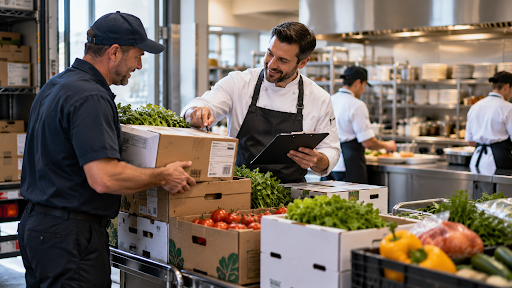
Growth is a positive sign for any foodservice business, but it also puts additional pressure on operations. More customers mean higher purchasing volumes, tighter inventory cycles, increased demand on kitchen teams, and less room for supply disruptions. Restaurants, caterers, schools, healthcare facilities, and hospitality businesses often reach a point where the suppliers that worked at a smaller scale can no longer support their changing needs. Building relationships with dependable wholesale food distributors can help growing businesses maintain product availability and consistent operations as purchasing volumes increase.
A reliable supply chain does more than prevent empty shelves. It gives businesses the confidence to expand menus, increase capacity, serve more customers, and potentially open additional locations without constantly worrying about whether essential products will arrive.
Growth Changes the Way Foodservice Businesses Purchase
A small operation may initially manage purchasing through several local vendors, retail stores, or occasional wholesale orders.
As volume increases, this approach can become difficult to maintain.
A restaurant serving 100 customers per day has different purchasing requirements from one serving several hundred. A catering company handling a few small events each month faces different supply challenges when it begins booking large corporate functions or multiple events on the same weekend.
Growth affects:
- order volumes;
- delivery frequency;
- storage requirements;
- inventory turnover;
- product consistency;
- administrative workload;
- purchasing budgets;
- demand forecasting.
Systems that work at a smaller scale may become inefficient as these requirements increase.
Supply consistency becomes particularly important because a growing business has more to lose when something goes wrong.
Product Availability Protects Menu Consistency
Customers expect consistency.
When someone orders a familiar dish, they generally expect it to look and taste the same as it did during their previous visit.
That becomes difficult when a business cannot consistently source the same ingredients.
Frequent substitutions can change flavor, appearance, portion size, preparation requirements, and food costs. Kitchen employees may also need additional training whenever specifications change.
For a single temporary shortage, this may be manageable. When substitutions become routine, however, they can undermine operational consistency.
Growing businesses should identify their menu-critical products and discuss availability with suppliers.
These products may include signature proteins, specialty ingredients, high-volume dairy items, particular sauces, or products with specific size and quality requirements.
The more important an ingredient is to the menu, the more important dependable availability becomes.
Increasing Volume Requires More Reliable Deliveries
Growth often changes not only how much a business orders but also how frequently it needs deliveries.
Larger order volumes can quickly exceed existing storage capacity.
A restaurant may not have enough refrigeration or freezer space to hold an entire week’s inventory. Caterers may need deliveries aligned with upcoming events. Schools and healthcare facilities may operate meal programs that require regular replenishment according to fixed schedules.
Predictable distribution allows businesses to plan inventory around delivery frequency.
When operators know when products will arrive, they can maintain appropriate stock levels without filling storage areas with excessive safety inventory.
Unreliable deliveries create the opposite effect.
Managers may begin ordering additional products “just in case,” tying up cash and increasing the risk of spoilage.
For growing businesses, delivery reliability therefore becomes part of inventory strategy.
Supply Problems Become More Expensive at Scale
A shortage that is inconvenient for a small operation can become significantly more expensive as volume grows.
Consider a restaurant that suddenly runs out of a frequently used ingredient.
At a smaller scale, a manager might purchase a few units from a retail store. At higher volumes, replacing the same product could require a large emergency purchase at retail prices.
The financial impact grows with the business.
Supply problems can lead to:
- emergency purchasing;
- more expensive substitutions;
- lost menu sales;
- additional employee labor;
- inconsistent portions;
- delayed production;
- customer dissatisfaction.
This is why growing businesses should evaluate suppliers not only according to current needs but also according to expected future volume.
A supplier that can reliably support today’s purchasing requirements should also have the capacity to handle reasonable growth.
A Broader Product Range Can Simplify Expansion
Growth often introduces new purchasing requirements.
A restaurant may add breakfast service, catering, takeout, or delivery. A hospitality business may expand food and beverage operations. A catering company may begin serving larger events with more diverse menus.
Each new service can introduce additional ingredients and supplies.
If every expansion requires finding several new vendors, procurement quickly becomes complicated.
Working with a broadline distributor can help consolidate purchasing across multiple categories.
Foodservice businesses may be able to source meat, seafood, dairy, produce, frozen foods, dry groceries, beverages, disposables, and operational supplies through fewer relationships.
This can simplify administration as purchasing volume grows.
Fewer supplier accounts can mean fewer invoices, delivery schedules, ordering systems, and vendor contacts for managers to coordinate.
Consolidation should not eliminate specialty suppliers that provide unique value. Instead, businesses can use a broadline distributor for core purchasing while maintaining selected specialty relationships where they make operational sense.
Consistency Makes Food Costing More Accurate
Growth requires better financial visibility.
Owners and managers need to understand whether increased sales are actually producing increased profit.
Ingredient consistency plays an important role in this calculation.
If product specifications frequently change, recipe costs become harder to predict. Different pack sizes, yields, portion weights, or quality levels can change the true cost of a menu item.
Consistent products make costing more reliable.
Restaurants can build recipes around known yields and portion sizes. Caterers can estimate ingredient requirements for events more accurately. Institutional foodservice operations can budget meals with greater confidence.
This becomes increasingly important as purchasing volume rises.
A small difference in cost per serving may seem insignificant, but when multiplied across thousands of servings, it can materially affect profitability.
Growing Businesses Need Better Forecasting
Growth rarely happens at exactly the same rate every week.
Demand may increase gradually, fluctuate seasonally, or spike around events and holidays.
Businesses need forecasting systems that account for these changes.
Historical sales and purchasing data provide a useful starting point. Managers can compare previous periods and identify recurring patterns.
However, past data should be combined with information about future changes.
A restaurant planning a major promotion should communicate expected demand to its supplier. A caterer with several large events scheduled for the same weekend should plan purchases well in advance. A school should adjust orders around holidays and changes in enrollment.
Sharing relevant forecasts with distributors can help both sides prepare.
Good supply relationships depend on information flowing in both directions.
Businesses communicate expected demand, while distributors provide information about product availability, lead times, and potential substitutions.
Opening a Second Location Creates New Supply Challenges
For restaurants, one of the clearest signs of growth is opening another location.
This also introduces new supply chain complexity.
Owners may want both locations to use the same ingredients and maintain similar menu standards. However, ordering independently can result in different products, prices, and purchasing practices.
Standardization becomes valuable.
Businesses can establish approved product lists, specifications, and ordering procedures across locations.
A distributor capable of serving both locations can make this easier.
Centralized supplier relationships may allow owners to compare purchasing between locations and identify differences in usage.
For example, if two restaurants have similar sales but one consistently purchases significantly more of a particular ingredient, managers can investigate portioning, waste, or inventory practices.
Supply consistency therefore supports not only purchasing but also operational control.
Customer Expectations Rise With the Business
As foodservice businesses become more established, customer expectations often increase.
A growing restaurant may develop a reputation for specific dishes. A catering company may begin working with corporate clients that expect precise execution. A healthcare or educational foodservice operation may serve increasing numbers of people according to structured menus.
Inconsistent supply can make these expectations harder to meet.
Customers generally do not care why a preferred item is unavailable. From their perspective, the business simply failed to provide what was expected.
This makes supply reliability part of the customer experience, even though customers rarely see the distribution process behind it.
Consistent ingredients support consistent menus, and consistent menus help build trust.
Flexibility Matters as Needs Change
Growth is rarely completely predictable.
A business may introduce new products, change menu concepts, expand into catering, add delivery service, or experience unexpected increases in demand.
Suppliers need to provide enough flexibility to accommodate these changes.
Special-order capabilities can be valuable when businesses need products outside a distributor’s regular assortment.
Alternative products are equally important.
If a particular brand or specification becomes temporarily unavailable, access to suitable alternatives can help businesses continue operating without major disruption.
The strongest supplier relationships provide both consistency and flexibility.
Businesses need dependable access to core products while retaining the ability to adapt when requirements change.
Communication Becomes More Important at Higher Volumes
When purchasing volumes are small, informal communication may be sufficient.
As operations expand, businesses need clearer processes.
Managers should know who to contact about orders, deliveries, product questions, substitutions, and account issues.
Supplier representatives should also understand the customer’s operation.
A restaurant group may have different requirements from a school cafeteria or healthcare facility. A catering company may have highly variable demand based on its event schedule.
Regular communication allows both sides to anticipate needs rather than simply react to problems.
This can include discussing upcoming volume increases, seasonal menu changes, new locations, or products that are becoming increasingly important to the business.
A distributor that understands where a customer is heading can be better prepared to support that growth.
Know When Your Current Supply System Has Reached Its Limit
Growing businesses should periodically evaluate whether their existing purchasing system still works.
Several warning signs can indicate that change is needed:
- emergency purchases are becoming frequent;
- managers spend excessive time coordinating vendors;
- deliveries are inconsistent;
- important products are regularly unavailable;
- order volumes exceed supplier capabilities;
- storage is crowded because deliveries are too infrequent;
- different locations are purchasing inconsistent products;
- obtaining new products has become difficult.
These problems may not be significant individually.
Together, however, they can indicate that the supply system has not kept pace with the business.
Addressing the problem early is generally easier than waiting until supply issues begin affecting customers.
Build Supply Capacity Before You Need It
One common mistake is waiting until after growth occurs to improve supply infrastructure.
A better approach is to prepare in advance.
Restaurants planning new locations can evaluate distribution capabilities before opening. Caterers expecting larger contracts can discuss anticipated volumes with suppliers. Institutional foodservice operations can review delivery and storage requirements before expanding programs.
This provides time to identify limitations and establish new processes before demand increases.
Supply chain planning should therefore be part of growth planning.
Businesses routinely consider staffing, equipment, kitchen capacity, marketing, and financing when preparing to expand. Supplier capacity deserves the same attention.
Choosing a Distribution Partner That Can Support Growth
A foodservice distributor should be able to meet current requirements while providing enough product selection, logistics capacity, and customer support to accommodate future growth.
Businesses should evaluate delivery reliability, product availability, ordering options, geographic coverage, temperature-controlled logistics, and the distributor’s experience with different types of foodservice customers.
For foodservice businesses operating in Ohio, Atlantic Food Distributors is an established regional option. The family-owned company has served the industry since 1960 and supplies restaurants, schools, healthcare facilities, and other foodservice operations across Ohio. Its core assortment covers thousands of products across major food and foodservice categories.
Companies looking to strengthen their supply chain as they grow can Become a customer Atlantic Food Distributors and explore whether its distribution services fit their current and future purchasing requirements.
Growth creates opportunities, but it also exposes weaknesses in systems that previously worked at a smaller scale. A consistent supply chain gives foodservice businesses a stronger operational foundation, helping them increase volume while maintaining product quality, menu consistency, cost control, and dependable service.