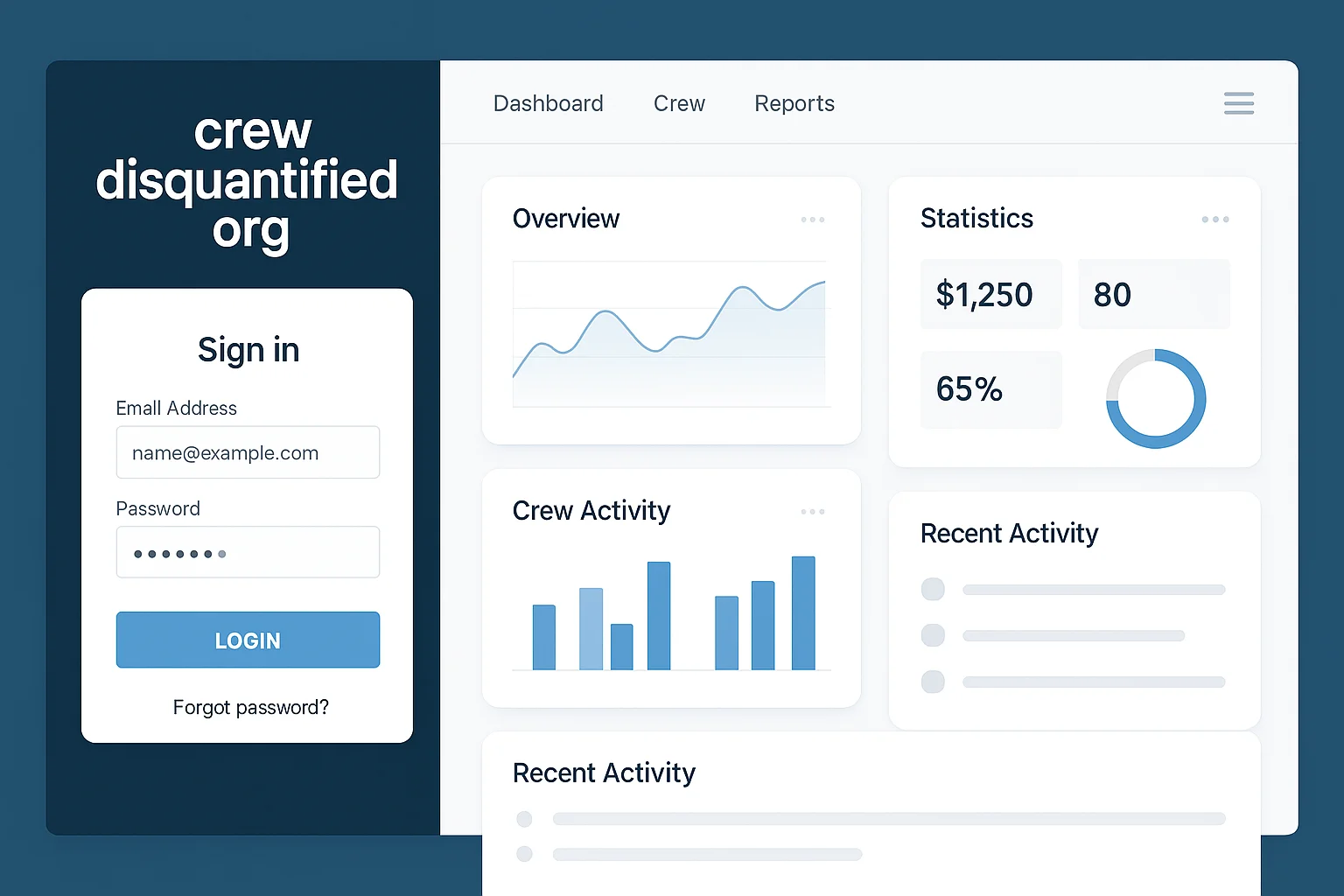
Crew Disquantified Org refers, in the website’s own team and contact context, to the people behind Disquantified.org. The site includes navigation labeled “About the Team” and “Contact The Crew,” alongside sections such as Finance, Finance Advisor, and Investing.
For readers, the practical purpose of these pages is to learn about the publisher and find a route for questions or feedback. They should not be confused with a workforce-management dashboard, a crew-scheduling service, or a database of disqualified personnel.
Understanding that distinction makes it easier to use the website appropriately, assess its articles, and direct an inquiry to the right place.
What Is Crew Disquantified Org?
Disquantified.org uses “crew” in connection with its website team. Its contact page is titled “Contact The Crew,” while its navigation provides a separate route to information about the team.
The website also publishes articles discussing its contributors and activities. Those descriptions represent the publisher’s account of its work; they do not independently establish professional qualifications, technical capabilities, or the accuracy of every article.
A useful starting point is to distinguish three things: the website itself, the people credited with its content, and any external businesses mentioned in an article. A reference to another company does not automatically establish a partnership or endorsement.
What Readers Can Find on Disquantified.org
The homepage presents articles and topic sections, including finance and investing. It also displays content covering other subjects.
Readers can use the site’s navigation to explore a section or open an individual article. For a specific question, the article itself is the most important place to inspect the author, publication details, supporting sources, and scope of the explanation.
A category label describes how a publisher organizes content. It does not establish that every article in that category has been written or reviewed by a qualified specialist.
How to Learn About the Team
Start with the “About the Team” page linked from the website’s navigation. Then examine the byline on the article you are reading and any linked author information.
These pages serve different purposes. A team page introduces the publisher, while a byline identifies who is credited with a particular piece of content.
When assessing a contributor, look for information relevant to the subject:
- A clear description of the person’s role.
- Experience connected to the article’s topic.
- Links to previous work or supporting credentials, where applicable.
- Transparent attribution of research, quotations, and outside sources.
An author’s title or biography can provide context, but the article still needs evidence for its factual claims.
How to Contact the Crew
Disquantified.org provides a dedicated Contact The Crew page. At the time of review, it displayed a contact form with fields for a name, email address, and message.
Use the contact details currently published on that page rather than relying on an address copied into an older third-party article. Contact methods can change.
Ask About a Specific Article
Include the article title and URL so the recipient can identify the page. Describe the question directly and point to the relevant passage.
A focused inquiry is easier to assess than a general message saying that an article is confusing or incorrect.
Request a Correction
Identify the statement that needs attention and explain the issue. If a reliable source supports your correction, include its link and specify the information that differs.
For example, a correction request could identify an outdated product specification and link to the manufacturer’s current documentation.
Keep the request limited to the evidence. There is no need to speculate about why an error occurred.
Discuss Contributions or Collaboration
Use the contact page to ask whether the publisher currently accepts the type of contribution you have in mind.
Explain your proposed subject, relevant experience, and the material you can provide. Do not assume that submission guarantees acceptance, payment, publication, or a particular link arrangement.
Those terms should be confirmed directly before work begins.
What to Include in a Useful Message
A clear message usually needs only a few details:
- Purpose: State whether you have a question, correction, or proposal.
- Relevant page: Include the article URL, if applicable.
- Specific point: Explain the issue or request.
- Supporting information: Add a source or example when it helps.
- Requested response: Say what clarification or action you are seeking.
Avoid including passwords, identification documents, payment information, or unrelated personal records in an ordinary website inquiry.
Keep a copy of your message if you may need to follow up. A publisher’s stated response target should be treated as an expectation rather than a guaranteed reply time.
Is It a Crew-Management Platform?
The public pages reviewed for this article do not establish Disquantified.org as a crew-management software service.
In particular, they do not substantiate the earlier claims about shift scheduling, employee tracking, payroll connections, freemium subscriptions, or integrations with project-management tools.
Before evaluating any website as operational software, look for product documentation that identifies the functions it provides. A service offering scheduling or workforce tools should be assessed through its actual application, support documentation, commercial terms, and data-handling information.
A team page or an article describing collaboration is not evidence of those software capabilities.
How to Assess Articles Before Relying on Them
Evaluate each article on its own merits. Useful checks include whether the content identifies its sources, distinguishes opinion from fact, and provides enough detail to verify important statements.
Check the Evidence
Follow links supporting significant claims. Confirm that the source actually addresses the claim rather than merely discussing the same broad topic.
For product features, consult the relevant provider’s documentation. For research findings, look for the original study and its limitations.
Check Dates and Scope
Information can become outdated, especially when it concerns products, services, prices, or policies.
A recent update date is useful context, but it does not prove that every section has been checked. Compare time-sensitive details with their original sources.
Separate Information From Promotion
An article may discuss or link to a commercial service. Consider whether it explains its selection criteria and discloses any relevant commercial relationship.
A favorable description alone is not a demonstrated comparison or an independent test.
Frequently Asked Questions
Does “crew” mean aviation or maritime personnel here?
The team and contact navigation reviewed on Disquantified.org uses “crew” in a website-team context. It does not establish an aviation or maritime personnel service.
Is Crew Disquantified Org a separate website?
The pages reviewed are hosted on Disquantified.org. The wording should not be treated as proof of a separate domain, application, or organization.
Do I need to create a crew-management account?
The public contact form reviewed did not require a crew-management account. Follow the instructions on the current contact page for an ordinary inquiry.
Are subscriptions or API integrations confirmed?
This review did not establish software subscription plans or API integrations. Do not rely on earlier claims about pricing or connections to payroll, HR, or project-management systems without direct documentation.
Where should I send feedback?
Use the contact page linked from Disquantified.org and include the specific article or issue you want the team to review.
Using the Website With Clear Expectations
Crew Disquantified Org is best understood through the website’s own team and contact pages. Readers can use those pages to learn about the publisher, ask questions, and submit focused feedback.
The useful distinction is between a publishing website and an operational software product. Assess the articles through their evidence, and verify any claimed service through documentation that directly supports it.